សេចក្តីជូនដំណឹង
សេវាប្រឹក្សាយោបល់ផ្នែកជំនាញកសិកម្ម នៃអង្គការ NASTO សូមប្រកាសផ្អាកមួយរយៈពេលវែង ដោយគ្មានការកំណត់ អាស្រ័យហេតុនេះសូមសិក្ខាកាម និងមិត្តអ្នកអានទាំងអស់មេត្តាជ្រាបជាដំណឹង, សូមអរគុណ
Showing posts with label Facts and Figures. Show all posts

Tuesday, April 10, 2012

The Iditarod (Last Lesson of Facts & Figures)

Every year in early March, dogs pull sleds in a race along the Iditarod Trail. This trail is 1,770 kilometers long. It goes from Anchorage to Nome, Alaska. The people who drive the dog teams are called mushers.

A musher is an adventurer. He runs by himself with his dogs. Some mushers are women. Susan Butcher is a famous musher. She won the Iditarod race four times. Rick Swenson won the race five times.

Mushers are very brave to go on this adventure. The dogs run across snow and ice pulling their sleds. Sometimes the mushers ride, and sometimes they walk. In 1991, Rick Swenson led his dogs through a snow storm. It was so dark that no one could see. He fell to his knees and got up again. In 1990, Susan Butcher's dogs got sick. Then they came to a river where there was water on top of ice. They were very lucky that they didn't fall through the thin ice. No one could live in the icy water below.
At night the mushers sleep in tents. In the morning they can see footprints of wild animals near the camp. Sometimes they have to shoot at the wild animals to make them go away.

Friday, April 6, 2012

The European Raja of Sarawak

James Brooke (1803-1868) was born in India. However, he was British, not Indian. India was a British colony at that time, and James's father was an official in the colonial government.

James attended school in England, and then he went into the army. He was injured in a war in Burma, so he left the army. He bought a boat and explored the islands off the coast of Asia.

Sarawak is on one of these islands. The name of the island is Kalimantan. Today most of Kalimantan belongs to Indonesia. While Mr. Brooke was traveling in Asia, there were problems in Sarawak. Some of the people did not like their leader, the raja, so they started fighting against him. The fighting continued and the raja couldn't stop it. Finally, he asked Mr. Brooke for help.

Mr. Brooke asked the British navy to help him. They soon defeated the raja's enemies.

Friday, March 30, 2012

The First Woman on Mount Everest

Mount Everest is the highest mountain in the world. It is in the Himalayan Mountains between Nepal and China, and it is 8,900 meters high. Sir Edmund Hillary from New Zealand and Tenzing Norgay from Nepal were the first people ever to climb Mount Everest. They climbed it in 1953. Men from several different countries climbed it after that.

Junko Tabei, a Japanese from Hokkaido, was the first woman to make this difficult climb. A Tokyo newspaper-television company organized the Mount Everest climb in 1975. They chose fifteen women from mountaineering clubs to go to Nepal. The group climbed for several days. Then there was an avalanche. The heavy ice and snow injured ten of the women. They had to stop climbing. The other five continued. 

Only Ms. Tabei was able to climb the last 70 meters. She was standing on top of the world. She was the first woman there. Ms. Tabei was 35 years old at the time. She started climbing mountains in 1960. She still climbs mountains. She is not an ordinary Japanese housewife. Her husband works for Honda Motor Company. He likes to climb mountains, too. But he can't have enough vacation from his work to go with his wife all the time. So he stays home to take care of the house and children.

Tuesday, March 27, 2012

A Giraffe in Central Asia

Tamerlane (1336?-1405) was a very strong Mongol leader. He and his soldiers fought until Tamerlane became the ruler of all Central Asia. Other countries wanted to make friends with Tamerlane. It was safer to be friends than enemies. 

Ambassadors from many countries took gifts to Tamerlane. They took beautiful cloth, jewelry, gold (Au), and silver (Ag). They  often tried to take something unusual as a gift too. 

In 1404, near the end of Tamerlane's life, an Egyptian ambassador arrived in Samarkand. This was where Tamerland lived. The ambassador and his men traveled on horses and camels. They brought a giraffe from Aftica as a gift.

Egyptian camels and horses were used to walking in the desert. They did it all the time. A giraffe is not used to the desert. But this giraffe walked 5,000 kilometers from Cairo to Samarkand.

The Polynesians

The Polynesians were probably the best explorers in the history of the world. They traveled thousands of kilometers across the Pacific Ocean in large double canoes. They could look at the stars and know which way to go. They also understood the wind and ocean currents. They made maps of the stars and ocean currents. They made these maps out of sticks and shells. About four thousand years ago a group of people lived in southern China. They were a mixture of white, black, and Mongol people. When the Chinese moved father and father into the south, these people needed to find safer homes.

Slowly these Polynesians left China in their double canoes and started toward the southeast. They look animals and plants with them. A group of people might arrive at an island and stay there until they had children, grandchildren, and great-grandchildren. Then a few families might start traveling again. Some canoes went one way and some another. It took hundreds of years for them to reach all of the islands in Polynesia.

Saturday, March 24, 2012

The Maori of New Zealand

Polynesians live on islands in the Pacific Ocean. The Maori are Polynesians and they live at the southern end of Polynesia in New Zealand. There are about 280,000 Maori today.

Maori, like other Polynesians, have brown skin, dark brown eyes, and wavy black hair. Men have beards and mustaches, but they usually shave them.
The Maori arrived in New Zealand from other Polynesian islands over a thousand years ago. They were the first people to live there. They made beautiful wooden buildings with pictures cut into the wood. There was one terrible thing about their life. They fought wars among themselves fro several centuries. Then British people came to live there in the 1970s, and some of the Maori fought them. In 1840 they agreed to become a British colony. This brought peace to the country. When they stopped fighting, they learned European ways quickly.

Tuesday, March 20, 2012

The Hopi of Arizona

The Hopi live in the northeastern part of Arizona in the United States. The United States is a very modern country. Tall buildings, highways, computers, and hundreds of other modern things are a part of every American's life. Somehow, with modern things all around them, the Hopi keep their traditions.

There are about ten thousand (10,000) Hopi and their live in twelve villages in the desert. The weather is very hot in summer, but in winter it freezes. The wind blows hard. Farming is difficult. Corn is the Hopi's main food, but they plant vegetables too. They raise sheep, goats, and cattle. They also eat hamburgers and ice cream and drink soft drinks. They live intraditional stone houses, but many of them have telephones, radios, and television. They have horses, but they have pickup trucks too. 

Kachinas are an important part of the Hopi religion.Kachinas are spirits of dead peole, of rocks, plants, and animals, and of the stars. Men dress as kachinas and do religious dances.

The Yanomami of the Amazon

The Yanomami people live in the Amazon forest between Venezuela and Brazil. They live in the tropical forest far away from other people. There are about 20,000 of them in 200 villages. Before scientists visited them, they knew nothing about other people in South America, about the government, or about modern life. They did not know they lived in Brazil or Venezuela. They lived in their own world. The Yanomami were Stone Age people. They used stone tools. They had stone axes for cutting. They used bamboo knives. They ate bananas and palm fruit and hunted animals. Sometimes they are frogs and insects. They wore a few leaves for clothes. Then government officials and scientists started to visit them often. They were studying the Yanomami for an unusual reason. The Yanomami are some of the most violent people on earth. They kill each other often. They get angry quickly and stay angry for years. They hit their enemies with long sticks. Their villages are usually at war. Scientists want to know why humans make war. Other groups of people live together and do not make war. Why are the yanomami so violent?

Monday, March 19, 2012

The Ainu of Japan

The Ainu live in northern Japan on the island of Hokkaido. They do not look like other Japanese. They have round, dark brown eyes and wavy hair. Their skin is not dark but light. The men have beards and mustaches. Where did these people come from? Did they come from Europe across Russia to Japan? Did they come from Indonesia? Are they completely different from all the other people in the world? Nobody knows the answer to these questions.

The Ainu were in Japan seven thousand (7,000) years ago. In modern times, the Japanese brought new diseases to Ainu villages. Many people died. Today there are only a small number of Ainu left. There are also about 25,000 peple who are part Ainu.

Friday, March 16, 2012

The Sami of Northern Europe

The Semi live in northern Norway, Sweden, Finland, and Russia. There are only about thirty-two thousand (32,000) of them, and most of them live a modern life on the coast or in the forests. Only a few of them live a traditional life. These few mountain Sami are called nomads because they move from one place to another with their reindeer. Their life is almost the same as it was a thousand years ago.

In winter the reindeer dig through the snow to find plants for their food. In spring these plants become very dry, and there are lots of insects. Then the Sami move their reindeer to the coast. The deer live on the thick grass there until winter. When the snow becomes deep, the Sami and their reindeer begin moving slowly back to their winter homes. There is less snow there.
These nomads live in tents because they move so often. They make shoes, jackets, and pants of reindeer skin. They also wear beautiful blue and red traditional clothes. They walk or travel on skis. They have sleds too. Reindeer pull the sleds.

Monday, March 12, 2012

A Chimney Sweep

Bruce Chapman is a chimney sweep. He is going to work. His clothes are unusual for a worker. He is wearing a tall hat, a formal coat, and a silk tie. He has a broom in his hand. Many chimney sweeps dress this special way. Now Bruce is ringing the bell. After he enters the house, he changes his clothes.

Sweeping chimneys is a very old and dangerous job. Chimney sweeps today use expensive, modern equipment instead of brooms. They only carry the brooms. They store their equipment in their trucks.
Bruce has air tanks so he does not breathe toxic substances. Now he is covering his body, face, and hands to clean the chimney. Bruce has tools of many different shapes. He is filling the room with his tools.

Bruce finds spider webs, insects, and a small dead animal in the chimney. Now the chimney is clean, but Bruce's work is not finished yet. He is cleaning the room and putting his tools back into the truck.

Wednesday, March 7, 2012

A Firefighter

Glenda Smith is a firefighter. Right now, she and many other firefighters are going to a terrible fire at a factory. The people at the factory are afraid. They want the firefighters to appear soon to put out the fire. The fire is very hot. It smells bad, and people cannot breath.

The firefighters are at the factory now. They are having some problems with the fire. There are rubber tires, fertilizer, tanks of gas, and other toxic substances nearby. These substances are very dangerous when they burn. They can pollute the air in the whole area.

Glenda Smith attended school to be a firefighter. She learned about dangerous substances. She knows how to help people breathe during a fire and how to carry large people. She can run and jump in difficult conditions.

Tuesday, March 6, 2012

A Computer Information Specialist

Katherine Boudreaux is a computer information specialist. Right now she is teaching a class about computers. She is teaching the workers how to change part of the computer. The computer is upside down, so she is holding on to it. 
In Ms. Boudreaux's class, the students are learning to relax. They feel afraid of the computers. Now, they have a computer beside them. Some of them are very nervous.
In room with computers, the temperature has to be exactly right, not too high and not too low. No dirt at all can get into the computers. For example, one worker cannot use his computer now because he is eating a sandwich.
Computer information specialists do many different jobs. They have to invent ways for computers to help managers and workers in all parts of a company. They also tell their company when to buy new computer and what kind to buy.

Monday, March 5, 2012

A Human Resources Manager

Wanda Cheung is a human resources manager. She works for a large company. Right now she is teaching a class. Her students are not children but adults. They are managers. They are learning how to talk with the workers and how to help them. They are finding answers to the worker's questions.

Modern companies understand that workers are people. Happy people work better and are more productive than unhappy workers. 
Wanda Cheung's job is to keep both the workers and the managers happy. Her job is also to motivate the workers. She is doing a good job. Her company is twenty percent more productive now than it was before.

Saturday, March 3, 2012

An Environmental Engineer

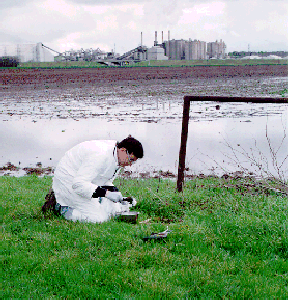
Stephen Martinez is an environmental engineer. He works in many places, both inside and outside. He works for companies and for the government. Today he is looking for dangerous gas and other toxic substances. Sometimes they have no taste or smell, but they can poison people, animals, or plants. He is testing the dirt, air, and water near a large factory. He is digging a hole. He is using special tools to collect samples.
Many countries need environmental engineers. In the modern world, more governments are paying for a cleaner environment. They do not want factories to pollute the earth, air, or water. They alo want factories to store toxic substances in a safe way. Now Stephen Martinez is covering the holes and finishing the tests. He is studying his mixtures and laying down his tools. He is finished for the day. Now he can relax.

Monday, February 27, 2012

Latin Music and Salsa

Latin music is very common in countries where people speak Spanish and Portuguese. However, now people all over the world can enjoy it. This music comes from Mexico, the Caribbean, Central America, and South America. "Salsa" is one kind of Latin music. Big cities like Miami, New York, San Juan, Havana, or Panama City have their own kinds of salsa. Latin music is a mixture of European music and African music. It has a strong beat. Many years ago people played Latin music mostly on guitars with drums, but now whole orchestras with lots of other instruments play it. Latin music sounds very emotional. Composers of Latin music express their feelings in their music. Sometimes they are very happy, and sometimes they are sad. Ruben Blades and Juan Luis Guerra are two famous modern Latin American composers. They perform their own music with their own orchestras. People can play Latin music and salsa at home or when they visit their friends.

Thursday, February 16, 2012

Country Western Music

Country western music is very old. It came from the United States, Canada, Ireland, and Great Britain. Country western music is a mixture of music from all of these places. In the American West, cowboys had to take care of the cattle. They had to watch them all day and all night because the cattle were nervous and sometimes ran away. A cowboy's life was lonely and dangerous. When he was alone in the desert with the cattle, he drank strong coffee with lots of caffeine to stay awake at night. He also sang music to the cattle to calm them. He sang about the stars and the moon, about his family and his friends. The caattle listened to the cowboy and went to sleep.

Rock and Roll

Rock and roll came from jazz and blues during the 1950s. One of the first rock and roll songs was Bill Haley's "Rock Around the Clock." One of the first very famous rock and roll singers was Elvis Presley. Others were Buddy Holly and Chuck Berry. Now, almost every country has many rock and roll bands and singers. Sometimes performers call their music by different names, like "rap" or "punk." They sing and play mixtures of rock and roll and talking or other sounds. "Rap" and "punk" both came from rock and roll, or "rock music." 
Some fans who like rock music think classical music is boring. Many fans play rock music very loudly. They forget about the people who enjoy soft music. Loud music can make these people nervous. Many fans also like to dance to rock and roll.

Sunday, February 12, 2012

Blues and Jazz

People from Europe and America brought Africans to America as slaves before and during the nineteenth century. These Africans brought their music with them. After the American Civil War (1861-1865), the African-American people in the United States were not slaves. Their African-American music became famous. It started in the South, in Louisiana and Mississippi. Then it traveled to the North. This music became blues and then jazz.
Blues and jazz became very popular in the twentieth century. A person who "sings the blues" feels sad. Usually, he or she lost something - a person or maybe money or a job. Blues express sad feelings, sometimes in a funny way. People played blues first with only one or two instruments, for example, a guitar, a harmonica, or sometimes a piano. Sometimes they sang without any instruments.

Tuesday, February 7, 2012

Classical Music

All over the world people listen to classical music. Classical music is difficult to describe. It means different things to different people.
Some famous classical composers were Bach, Vivaldi, Haydn, and Mozart. In their music, they did not tell a story or show strong emotion. They wanted to make a beautiful, interesting design. They wanted to write lovely sounds. Then composers started to interpret ideas.They told stories about wars, armies, and soldiers. They wrote about religion. Sometimes they composed music for holidays. They told love stories and showed strong emotion. Some of these composers were Beethoven, Schumann,